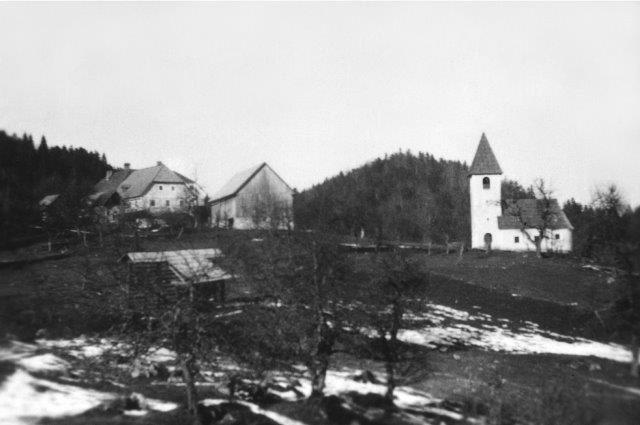
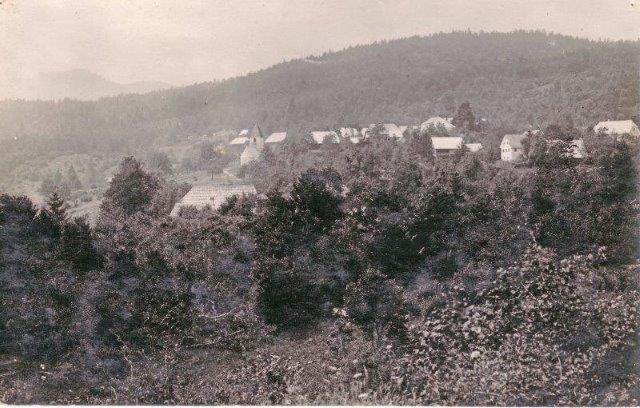
Podstenice is named after its location in a shallow valley near the rocky cliff below the top of Rog, both in Slovenian and German. The village was created quite late. It is not mentioned in the 1574 Urbarium of the Kočevsko. It is therefore believed to have been founded around 1580 by Countess Magdalena Blagajska and her son Jurij. It is probably one of the three villages in Kočevski Rog that gave rise to the complaint of the inhabitants of Novo Mesto to the Lord of the Land, who feared that in future they would have to supply the town with timber from more distant areas. They have therefore demanded that the disputed settlements be removed. The first actual mention of Podstenice dates back to 1614, when a landowner with the surname Grill lived in the village. The name remained in the local area until the 20th century.
Population
Podstenice was special among the Gottschee villages in many ways. Since 1880, it has been the only village where, along with the German inhabitants, the Slovene inhabitants have always been registered. It was also one of the few settlements in Kočevski Rog where the number of villagers increased at the turn of the 19th to 20th century, while censuses elsewhere mostly showed a significant decline. Although Podstenice also experienced similar trends after 1910 (in 1921, for example, the population decline was as high as 36%), in the decade before the Second World War, the situation began to improve again. In 1936, the census counted 82 villagers, only three fewer than in 1869, when 85 people lived in nine houses in Podstenice.
Location
The settlement’s location on the main road through the Kočevski Rog was important. At the turn of the 19th century, Podstenice was recommended to visitors of Dolenjske Toplice as a starting point for a visit to the village of Kunč with its ice cave and the remains of the building where Veronika Deseniška is said to have once hidden. Before the Second World War, a marked hiking trail from Podturn to Rog led past Podstenice.
Branches
Agriculture and livestock breeding in Podstenice were not abundant enough to meet all needs, so during both wars people sought income in charcoal production and timber transport, first to the Rog sawmill, and later to Straža. The Grill family’s tavern at the then house number 7 was also a meeting point for the cart drivers who transported logs from the forests of Kočevski Rog. In 1938, a steam sawmill of the timber merchant Pogačnik from Škofja Loka was put into operation in Podstenice. In the 1930s, however, there is no mention in the sources of the production of domestic beechwood products, which continued in the village after 1900. About half a century before that, the kiln for cleaning and calcination of potash, which once covered the entire Rog area from Podstenice, had also stopped operating.
During the war
In December 1941, 52 German inhabitants left the settlement. The settlement had had its own school since 1898. After a confrontation with the partisans, who formed several institutions in the empty space and established an infirmary in Lord Auerspeg’s villa in the foothills, the Italian army burnt the village in July 1942. It was later bombed twice. At the end of the war, all 16 houses were ruined. The settlement, near which there are two pits containing victims of post-war killings, has not been rebuilt by the authorities. In the place where the Auersperges already had a forest administration, only a logging and forestry house, a hunting lodge and a dwelling for forest workers with an attached stable were built. The remains of the church of St. Urh, which probably dates back to the 18th century, were removed. After 2000, local beekeepers converted the forestry house into a beekeeping home with a small museum collection.
Today
As of 2022, the National Statistical Office declared Podstenice, with a population of less than 0.08 inhabitants/km2, to be the most sparsely populated place in the country, as the settlement of Trnovec, which previously held this title, officially joined 53 other Slovenian places with no permanently registered inhabitants.