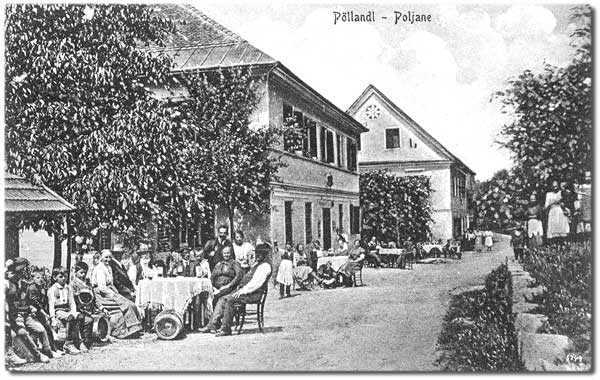
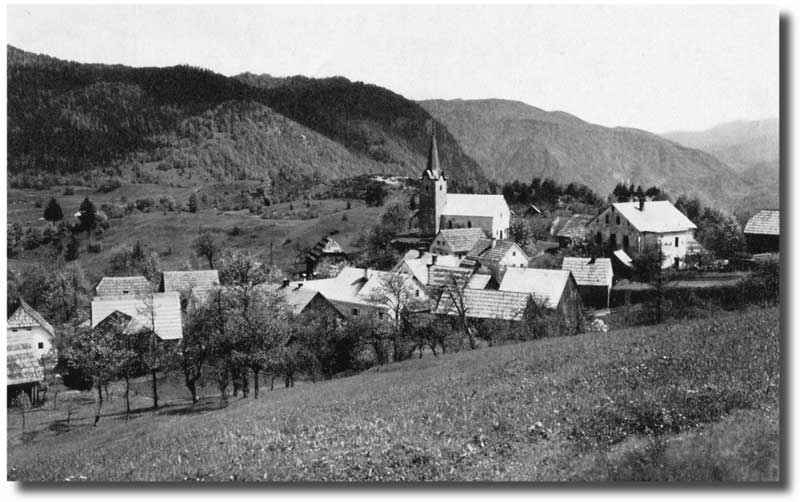
Kočevske Poljane, or Poljane for short, is one of the oldest settlements on the former German-language island. Although the settlement is not directly mentioned until 1564, the Poljane church is said to have been documented as early as in the 14th century. Based on the name, which denotes a place next to a field or fields, i.e., next to a plain or cultivated land, historians believe that the location was already inhabited by Slovenes before the arrival of the first German settlers. Similar place names can also be found in Slovene-populated places in Austrian Carinthia outside Slovenia.
Austro-Hungarian
Regardless of its name, in the 16th century, Poljane was inhabited exclusively by Germans. Austrian censuses also later never detected a significant number of Slovenes in the settlement. The proportion increased after the dissolution of the Austro-Hungarian Empire, however, Poljane remained a predominantly German town until the Second World War. However, in the last decades of the Habsburg monarchy, there were occasional public disputes as to whether the Poljane settlement was located on Slovenian or German national territory. For example, there was a controversy in the early 1890s, when the new parish priest allegedly declared that he would slovenize the parish within five years.
Kočevske Poljane
Poljane was not particularly large at first, as in the 16th century it consisted of only three whole farms (called huba), which at that time were divided among seven landowners, so it was estimated to only have around thirty to thirty-five inhabitants. In 1770, the village, which was the seat of a municipality and a parish, was supposed to have 29 houses, but only 12 houses and the church are shown on a military map from that period. According to the attached description, the church was also the only solid building in the town. In 1869, Poljane had the highest number of inhabitants, 243, but then a decline followed, which was particularly pronounced at the turn of the century and continued afterwards. In 1931, the number of villagers who lived in 43 houses, fell by almost a third in comparison to 60 years earlier.
Before war
Before the Second World War, the Local Lexicon of the Drava Banovina recorded that in Poljane, in addition to the school, which had existed since 1820, there was also a fire station. People earned their living by selling crops and fruit to Novo mesto, eggs were sold to Dolenjske Toplice, and wine in the local taverns. Livestock was sold at fairs and wood was transported to the steam sawmill in Straža. The parish of Poljane, which became independent in 1792, consisted of just over 500 people in the years before the war. Other sources add that the inhabitants of Poljane grew cereals and potatoes in the fields, and dried hay from the meadows on hayracks.
During war
At the beginning of December 1941, 117 people left the village as part of the ordered migration to Styria. Under the influence of some individuals, including the parish priest August Schauer, a native of Poljane, who died shortly before the move, a lower proportion of the German population in the Črmošnjice Valley decided to leave than elsewhere in Kočevsko. However, some of those who remained were expelled from Poljane, Občice and Stara Žaga by the partisans in May 1942, under the accusation of collaborating with the occupier and buying land from the Italian company Emona for their compatriots who wished to return. The village did not suffer major damage during the war, with only eight of the 31 houses damaged or destroyed at the time of liberation. 91 people lived there.
Development
The post-war development of Poljane was marked by the establishment of a farming cooperative, which operated until 1952, and by its renaming as Kočevske Poljane in 1953. The population, which initially grew to over 120 people in the post-war decades, started to decline again at the turn of the millennium, and until today it has fallen by a third. Due to its preserved building and urban heritage, Poljane has been designated as a cultural monument by a local ordinance, which includes, alongside the village houses and the cemetery with German gravestones, the late Baroque church of St Andrew and the nearby 17th-century pilgrimage church of St. Mary Help of Christians. The former parish barn of the village was converted into the August Schauer Cultural Hall in 2012 and 2013.