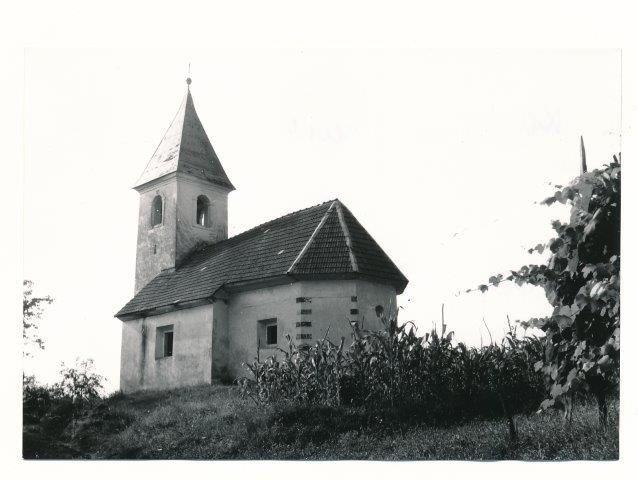
The village was first mentioned in written sources in 1574 as Schrigl. Originally it consisted of two whole farms (called huba); however, in the 16th century these two farms were divided among nine landowners, which meant the village had about 30 to 35 inhabitants at the time. Etymologists believe the toponym Riegel, which also appears in other names in Kočevsko, stems either from the elongated mountain ridge or pier on which the settlement was built, or from the land division of the holdings into strips, the latter being less convincing. The addition “Mali” (meaning small in Slovene) was added to distinguish the village from Veliki Rigelj (veliki meaning big in Slovene), located to the east of Kočevske Poljane.
First mention
According to historians, Mali Rigelj already existed around 1450, while Veliki Rigelj, which was located in the Meh nobility but was originally also a Gottschee village, could be slightly younger. The settlement was probably founded by German-speaking settlers, but in the 16th century, along with the German settlers, there were also inhabitants with surnames of Slovenian origin. Interestingly, in the 1930s, Mali Rigelj was said to be much larger than Veliki Rigelj, while the writer Janez Trdina mentioned in his notes a few decades earlier, that Veliki Rigelj had seven houses while Mali Rigelj only had four. The people in both villages were said to be wealthy, two of them even rich, Trdina wrote.
Emigration
Like many other villages in Kočevsko, Mali Rigelj has been also facing depopulation since 1890. In forty years, the number of villagers has fallen from 71 to just 48. Before the Second World War, the inhabitants earned their living as day labourers and as workers in a brick factory, where they made cement roofing bricks and pipes. They made extra income by selling wine and apples, although their own farming activities were not enough to cover their needs. There were fields and a few vineyards scattered around the village, which was accessible by a waggon at that time. Sources from the first half of the 20th century no longer mention the sale of chestnuts, for which the villagers of both Mali and Veliki Rigelj used to be known throughout Kočevsko and beyond.
Battalion
In December 1941, three families with 17 members left the village when the Gottscheers moved there. Data on how many remained varies. Some reports refer to only one family. Over time, Slovenians settled in the abandoned houses. In June 1943, Levstik’s Battalion was established in the village as a protective unit of the leadership of the partisan movement, which was formed by uniting smaller military groups. After the surrender of Italy, the battalion was transformed into the Levstik Brigade.
End of war
After the Second World War the village remained in a fairly good condition, with nine of the twelve houses still usable, but with only 26 inhabitants. This number decreased further in the following decades and was mostly around 20 villagers, who, according to official data, at the beginning of the 1970s were mostly selling firewood and logs in Dolenjske Toplice or were retired. The vineyards on the south side of the village were mainly owned by neighbouring villages.
Today
According to national statistical data, Mali Rigelj, the birthplace of Matthias Petschauer, the father of Dr Hermann Petschauer, author of the book Das Jahrhundertbuch: Gottschee and its People Through the Centuries, has fewer than 15 inhabitants. However, the data are unreliable as they also include people who are registered in the settlement but only occasionally visit their holiday homes. Another landmark, in addition to the cottages and houses listed in the Heritage Register, is the Church of St. Ursula which dates back to the first half of the 18th century and has a Baroque altar. In 1992, on the proposal of the conservators of Novo Mesto, it was declared a cultural monument of local importance.