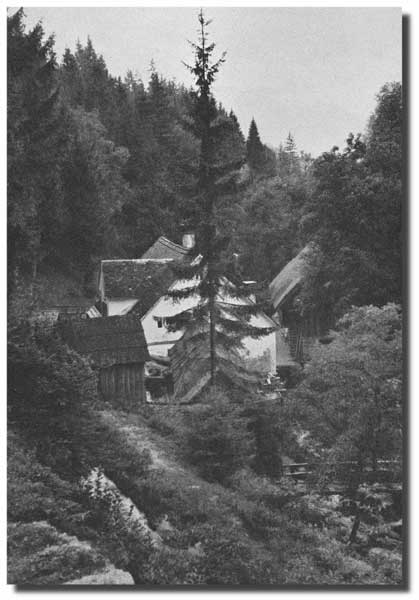
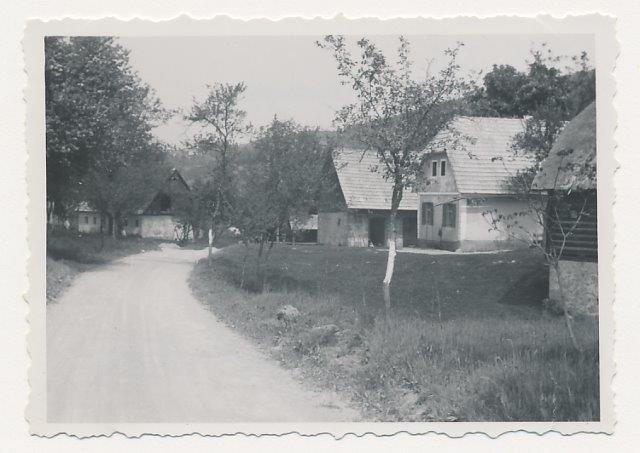
As the place name suggests, the area of the village of Stara Žaga, which stretches in the narrow valley of the Divji Potok stream, has been historically marked by sawmills. The gorge of the Divji Potok stream was particularly suitable for the development of sawmilling because of its steep drop. As early as in the 16th century, according to the Urbarium, there were six water-powered sawmills operating along the gorge, but historians believe that they had already been there much earlier. In addition to the sawmills, in 1574 there were also 23 mills in Stare Žage. Due to the lack of adequate production facilities, it was possible to make a relatively good living from sawn timber, so the Gottscheers transported the planks by wagons not only throughout Dolenjska and Bela Krajina, but also to Croatia.
During the wars
In the decades between the two world wars, 17 water-powered sawmills were in operation in Stare Žage, while the number of mills fell to nine. At that time, timber was mainly exported to Sušak, the nearest Yugoslav port. People were also involved in beekeeping. Honey was sold in Ljubljana. Some of the householders also had vineyards in Semiška Gora and Nova Gora.
Emigration
However, emigration started quite early. The highest number of inhabitants in Stare Žage was recorded in 1869, when 138 people lived in nineteen houses, and by the 1930s, with occasional fluctuations, the number of villagers had fallen to 97. In 1936, if the data is correct, only seven of the twenty houses were inhabited, and in the last years before the war, only two mills and two sawmills and a power plant owned by the landowner Josef Juran were still operating along the Divji potok stream.
During the war
At the end of December 1941, 77 German-speaking inhabitants moved out of Stare Žage. Due to the growth of the partisan movement, the Italian army burnt down most of the empty houses shortly afterwards, but after the capitulation of Italy, when many motor vehicles, weapons and technical equipment were confiscated, the partisans partially repaired the buildings and used them for storage of spoils of war and for the operation of partisan workshops. This led to the establishment of car repair, gunsmith, leather and shoemaking workshops, as well as workshops for repairing and recharging batteries and for relay stations reparation. At the same time, Stare Žage was a crossroads of partisan routes and an intelligence crossroads for the whole of Slovenia. Due to the proximity of the military and political leadership in Rog, many activists and party members gathered in the village, waiting for liaisons and assignments or to take up new tasks. After the offensive in October 1943, the Germans damaged the rifle workshop in Stare Žage, but also suffered significant losses due to landmine explosions. The partisan movement then restored production in the village. In addition to the mechanical, leather, tailoring, shoemaking, electromechanical and radio workshops, the settlement also housed the Central Partisan Hospitals with their own workshops. Some of them later moved to Črmošnjice and Srednja Vas, while the weapon workshops were located in Nova Gora after the offensive. The sawmill of Matthias Spreitzer, who did not emigrate with his compatriots, also supplied the partisan bases and outposts in Rog, including Base 20, with timber.
After the war
Although German soldiers again penetrated Stare Žage in April 1945, they caused only minor damage. At the end of the war, eleven of the twelve houses in the village were usable and 56 people lived there, including a few German-speaking villagers who had supported the partisans during the war. In the following decade, the population grew to 60. However, population started to decline and has almost halved to date. Most of the houses in the village centre are new or renovated, with the older buildings along the current road connection to Semič still partly showing typical features of Gottscheer architecture. Spreitzer’s sawmill and mill with a forge, which were maintained by his son until they were sold in 1960, have also been preserved. Other mills and sawmills have been in ruins for decades.